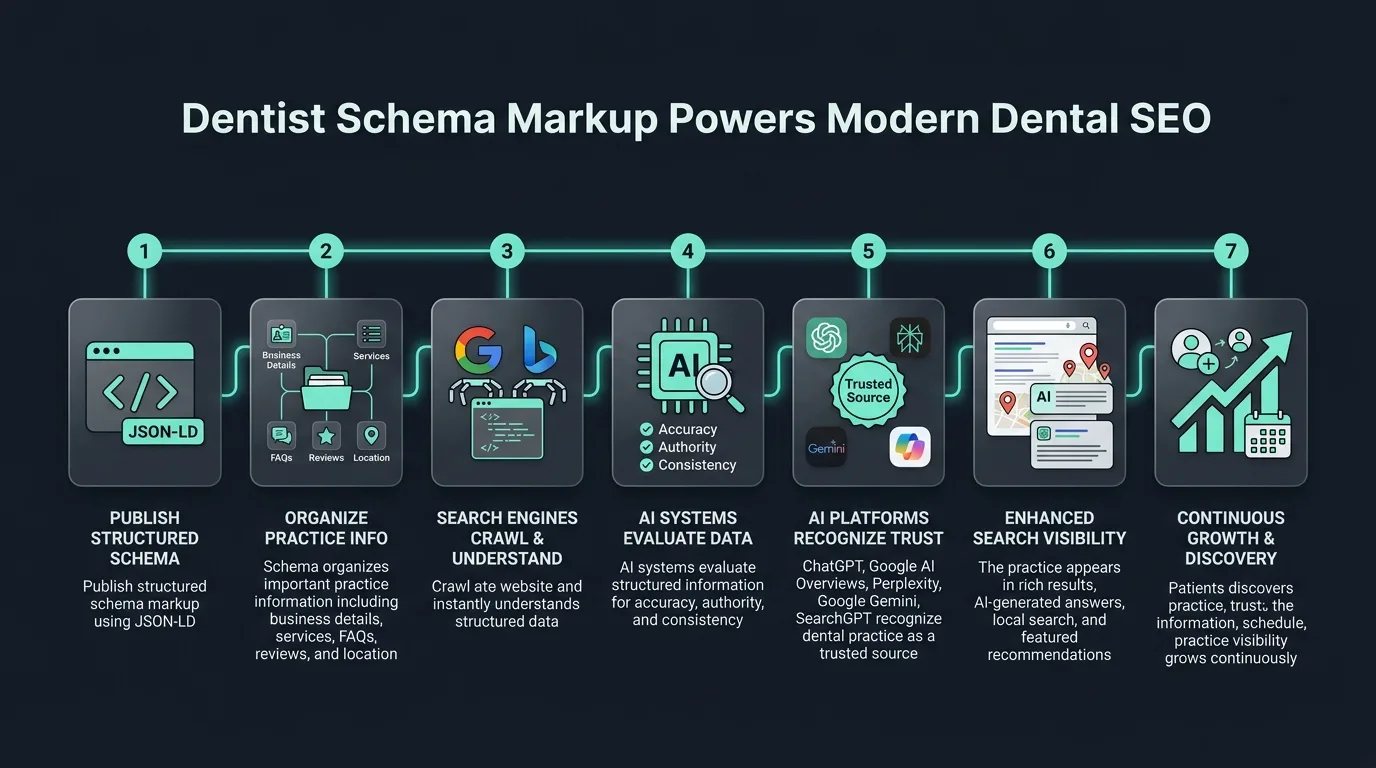
Key Takeaways
This guide walks through the complete process of implementing schema markup for a dental practice website. You will learn what schema markup is, which types every dentist needs, how to write and add the code correctly, how to test it, and how structured data directly supports your visibility in AI search engines like ChatGPT, Perplexity AI, Google Gemini, SearchGPT, and Microsoft Copilot. The guide also explains clearly why traditional dental SEO is no longer enough and why schema markup is a foundational requirement for both Generative Engine Optimization and Answer Engine Optimization in modern dental marketing.
- Structured Search Communication: Schema translates raw website copy into direct machine-readable metadata.
- JSON-LD Recommendation: Clean separation of script tags ensures markup can be tweaked without altering frontend code.
- Dentist Medical Type: Classifying your business under the Dentist subtype signals professional clinical status to Google.
- Rich Search snippets: Implementing aggregate reviews pushes eye-catching star ratings straight to standard SERPs.
- Structured Data That Gets Your Practice Found and Cited
- Understanding JSON-LD: The Right Format for Dental Schema Markup
- Implementing Local Business Schema for Your Dental Practice
- Adding Dentist and Medical Organization Schema
- Implementing FAQ Schema for AI Citations and Featured Answers
- Review Schema Implementation for Dental Practices
- Service Schema for High-Value Dental Treatments
- Testing and Validating Your Dental Schema Markup
- Schema Markup as the Foundation of GEO and AEO
- Final Thoughts
- Frequently Asked Questions
Structured Data That Gets Your Practice Found and Cited
Schema markup is one of the most powerful and most underused tools in dental SEO. It is code that lives on your dental website and speaks directly to search engines and AI tools in a language they understand perfectly. Patients never see it. But Google, ChatGPT, Perplexity AI, Google Gemini, and Microsoft Copilot read it every time they process your dental website. When it is implemented correctly, schema markup makes your practice easier to find, easier to trust, and far more likely to be cited as a verified source in AI-generated search answers.
This guide gives you a clear, step-by-step path to implementing schema markup on your dental practice website so that your dental SEO strategy works harder and your practice gets recognized by every major search and AI platform patients use today.
Understanding JSON-LD: The Right Format for Dental Schema Markup
Before getting into which schema types to implement, you need to know the right format to use. There are three ways to add schema markup to a website: JSON-LD, Microdata, and RDFa. For dental websites, JSON-LD is the only format worth using.
Google officially recommends JSON-LD. It is the cleanest and easiest to implement because it sits in a separate script block on your page rather than being woven into your HTML content. This means your web developer can add, update, or fix schema markup without touching the visible content of your dental website pages. It is also the format that AI tools and search engines process most reliably.
JSON-LD schema markup is added inside a script tag in the head or body section of each page on your dental website. It uses a structured format where each property and value clearly defines what a piece of information represents. Your practice name is not just text on a page. It is a defined, labeled entity that Google and AI tools can read with full confidence.
Every dental SEO specialist, dental SEO consultant, and dental SEO agency working on your website should be using JSON-LD as the default schema format. If a vendor suggests using Microdata or RDFa instead, that is a sign they are not current with best practices in dental search engine optimization.
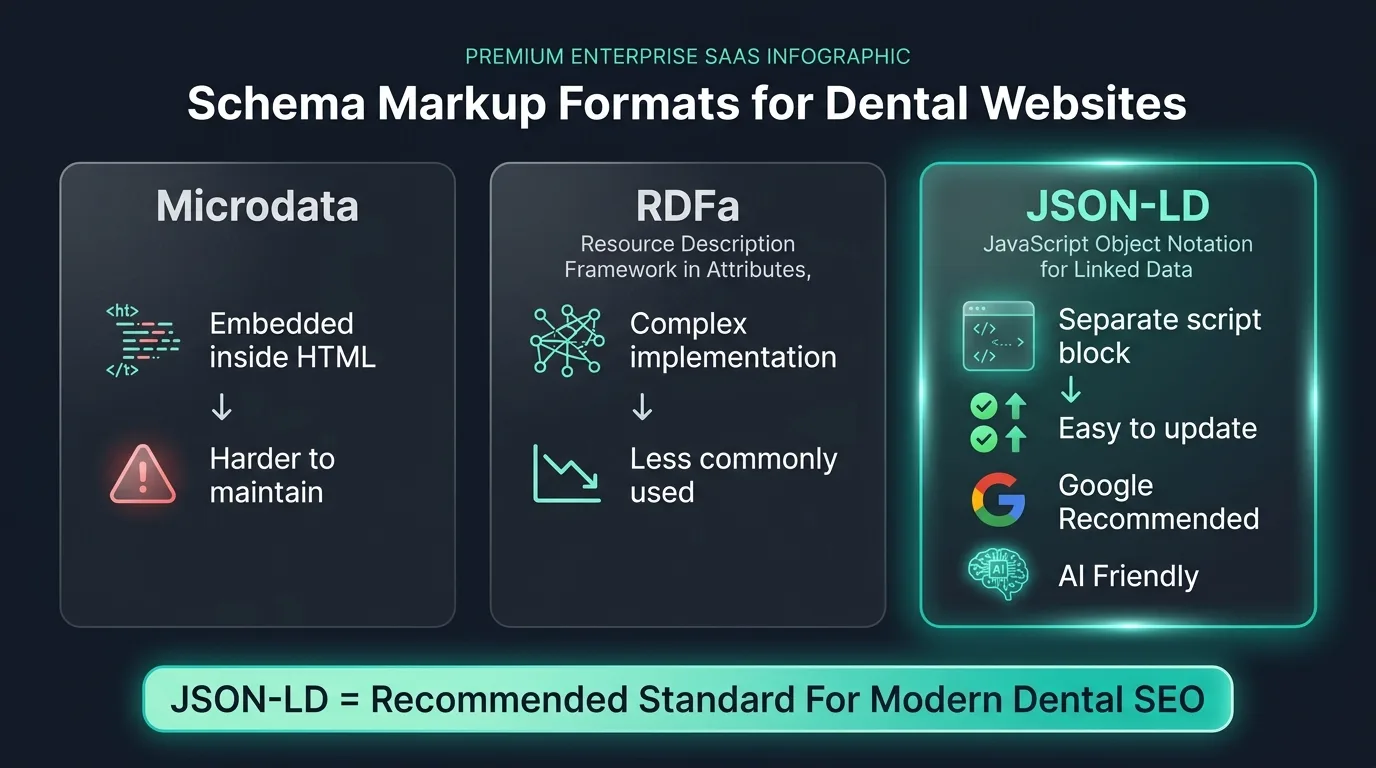 Figure 1: JSON-LD format segregates data variables from HTML DOM rendering for clean indexation.
 Implementing Local Business Schema for Your Dental Practice
Local business schema is the first and most critical schema type to implement on your dental website. It goes on your homepage and your contact page at minimum. For multi-location dental groups, it goes on every individual location page.
Here is what a complete local business schema implementation for a dental practice includes. The type field identifies your business as a Dentist, which is a specific type within the MedicalBusiness hierarchy. The name field contains your exact practice name as it appears on your Google Business Profile and other online directories. The address field includes your full street address, city, state, postal code, and country, each in its own labeled property. The telephone field contains your local phone number. The URL field links to your dental website homepage or the specific location page. The openingHours field lists your hours for each day of the week in a standardized format. The geo field contains your latitude and longitude coordinates. The priceRange field gives an indication of your fee level. And the image field links to a photo representing your practice.
Every single one of these fields matters. AI tools like ChatGPT and Google Gemini use this structured information when they answer questions like "find me a dentist in my city" or "what are the hours for this dental office." When your local business schema is complete and accurate, AI tools can cite your practice with full confidence. When it is missing or incomplete, AI tools have to piece together your information from unstructured text, which leads to errors and reduces the likelihood of your practice being recommended.
The NAP information in your schema, meaning your name, address, and phone number, must match exactly what appears on your Google Business Profile and in every online directory listing. Any inconsistency weakens your local dental SEO and reduces the trust signals AI tools use to verify your practice. Verify directory match configurations in our NAP consistency audit guide.
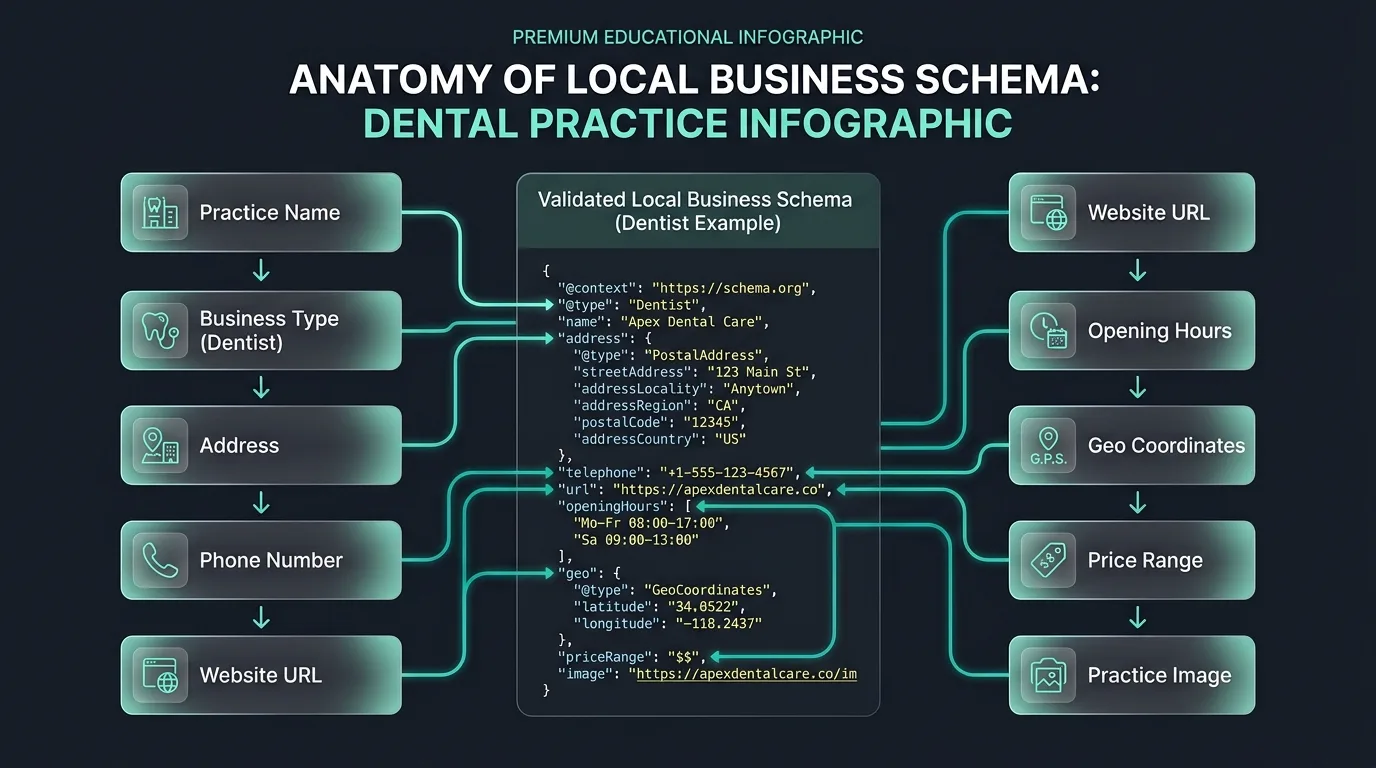 Figure 2: Complete local business schema maps exact practice identity, location coordinates, and operational parameters.
 Adding Dentist and Medical Organization Schema
Within the schema.org vocabulary, Dentist is a specific type that extends MedicalBusiness and LocalBusiness. Using the Dentist type rather than a generic LocalBusiness type communicates important context to search engines and AI tools. It tells them your practice is a licensed healthcare provider, not a general commercial business.
This distinction matters in dental search engine optimization because Google applies a higher standard of expertise and trustworthiness to healthcare-related content and businesses. A dental website that clearly identifies itself as a Dentist type through schema markup aligns with those standards more precisely than one that uses generic business types.
Within your Dentist schema, you can include additional properties that are specific to medical practices. The medicalSpecialty property lets you specify whether your practice offers general dentistry, orthodontics, oral surgery, pediatric dentistry, or cosmetic dentistry. This helps your practice appear for specialty-specific local searches and makes it easier for AI tools to recommend your practice to patients searching for a specific type of dental care. Check specialty listings on our GBP dental category mapping page.
The availableService property within your schema allows you to reference service schema entities for each treatment you offer. This connects your practice schema to your individual service schemas, creating a web of structured data that gives AI tools and search engines a comprehensive picture of everything your dental practice provides.
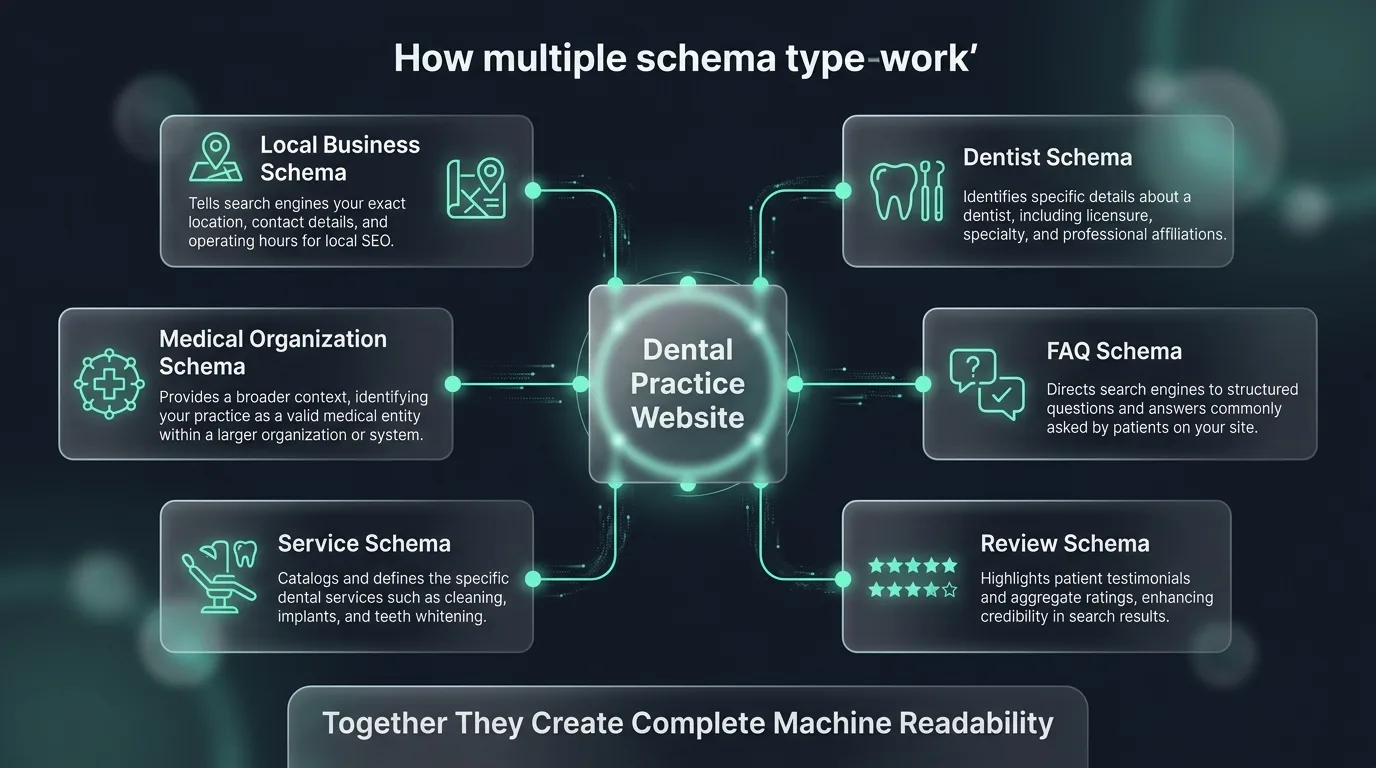 Figure 3: Classifying under the Dentist subclass inherits crucial medical safety and trust evaluations.
 Implementing FAQ Schema for AI Citations and Featured Answers
FAQ schema is the most direct technical tool for getting your dental practice cited by AI search engines. It marks up your question-and-answer content in a structured format that AI tools can extract and present as direct answers to patient queries.
Every major service page on your dental website should have a FAQ section, and every FAQ section should have FAQ schema applied to it. The schema marks each question and answer pair so that search engines and AI tools know precisely where each question starts, where the answer begins, and where it ends. Refer to our custom guide for setting up FAQ schema markup.
When a patient asks Perplexity AI "how much do dental implants cost" or asks Google Gemini "is Invisalign painful," these AI tools look for dental websites with clearly structured, factual answers. A dental website with properly implemented FAQ schema makes that search dramatically easier for the AI tool. The structured format removes ambiguity and tells the AI exactly which text is the answer to which question.
To implement FAQ schema correctly, each question must be written as a patient would genuinely ask it. Each answer must be complete, accurate, and written in plain language. The schema then wraps each question and answer pair in the defined FAQPage and Question markup types. Do not include promotional language in your FAQ schema answers. AI tools and Google specifically look for factual, informative content. Promotional answers can cause your schema to be ignored or your rich results to be removed.
FAQ schema is also what powers your ability to dominate Google's AI Overviews for dental search queries. Google AI Overviews pull from high-ranking pages with structured content. Service pages that have strong dental SEO rankings and FAQ schema applied to well-written question-and-answer content are the most consistently featured in these AI-generated overviews. Learn more in our Google AI Overviews guide.
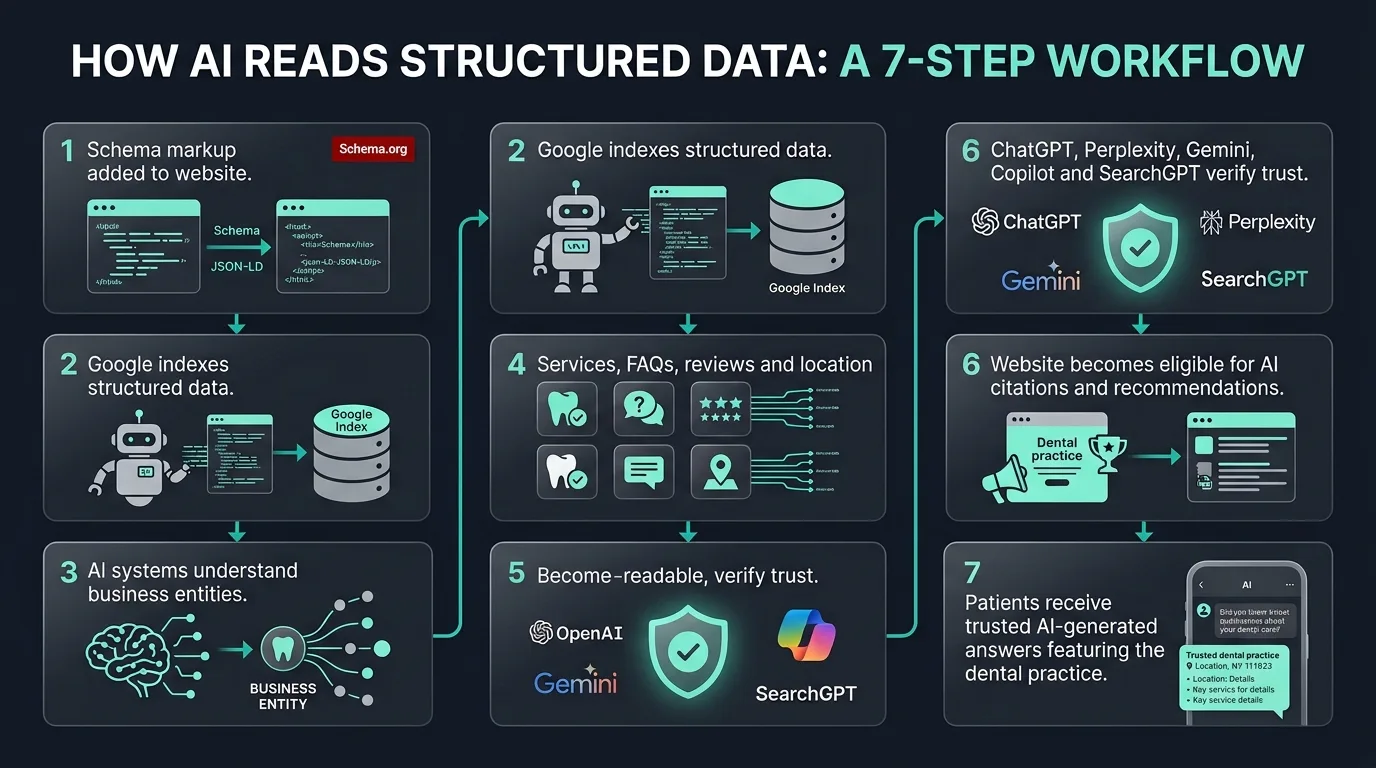 Figure 4: FAQ schema aligns question elements directly to answers, simplifying crawler parsing for rapid indexing.
 Review Schema Implementation for Dental Practices
Review schema communicates your patient review data to search engines in a structured format. When implemented correctly on your dental website, it can cause your star rating and review count to appear directly in Google search results as rich snippets.
The visual impact of star ratings in search results is significant for dental local SEO. Patients scanning through results are immediately drawn to listings with visible star ratings, and the presence of a rating builds instant credibility. This improves click-through rates from dental search results even when your ranking position stays the same. Read more on review collection setups in our guide to review generation systems.
For AI search visibility, review schema helps AI tools like ChatGPT and Google Gemini verify that your dental practice has a meaningful number of positive patient experiences. AI tools factor reputation signals into their recommendations. Structured review data that confirms a high rating makes your practice a more confident recommendation for AI tools when patients ask for dentist suggestions in your area.
Implement review schema using the AggregateRating type, which communicates your overall rating, the number of reviews that contribute to it, and the scale being used. This gives a precise, verifiable summary of your practice reputation that AI tools and search engines can read and trust.
Service Schema for High-Value Dental Treatments
Service schema allows you to mark up each dental treatment as a distinct, structured service entity on your dental website. This is especially valuable for high-value services like dental implants, full arch cases, cosmetic dentistry, and orthodontic treatment.
For dental implant marketing, service schema tells AI tools explicitly that your practice offers dental implants as a defined service. When a patient asks an AI tool to recommend dental implant providers in their city, practices with dental implant service schema are more precisely identifiable as matching results. This precision directly translates into more AI tool citations and more implant consultation inquiries. Read specialty layout suggestions in our dental implant page SEO guide.
Each service schema entry should include the service name, a clear description of the treatment, and ideally a connection to the provider schema for your practice. This linking between service schema and local business schema creates a structured relationship that gives AI tools a complete and connected picture of your practice and its offerings.
Testing and Validating Your Dental Schema Markup
Implementing schema markup without testing it is a common and costly mistake in dental website SEO. Schema errors can cause your structured data to be completely ignored by Google and AI tools, meaning all the work of implementation produces no benefit.
- Validation Checks: Use Google's Rich Results Test tool to validate each page of your dental website after adding schema markup. Enter the URL of each page and the tool will show you exactly which schema types it detected, whether they are valid, and what errors or warnings need to be addressed. Fix every error the tool identifies before considering the implementation complete.
- Ongoing Monitoring: Google Search Console provides ongoing monitoring of your structured data across your entire dental website. The Enhancements section of Search Console shows you which pages have valid rich results, which have errors, and which have warnings that may prevent your schema from performing at its full potential. Monitor this section regularly as part of your dental SEO maintenance routine. Read more in our Google Search Console tracking guide.
- Update Protection: Test your schema after every major update to your dental website. Changes to page templates, content management systems, or website themes can accidentally remove or break schema implementations that were previously working correctly.
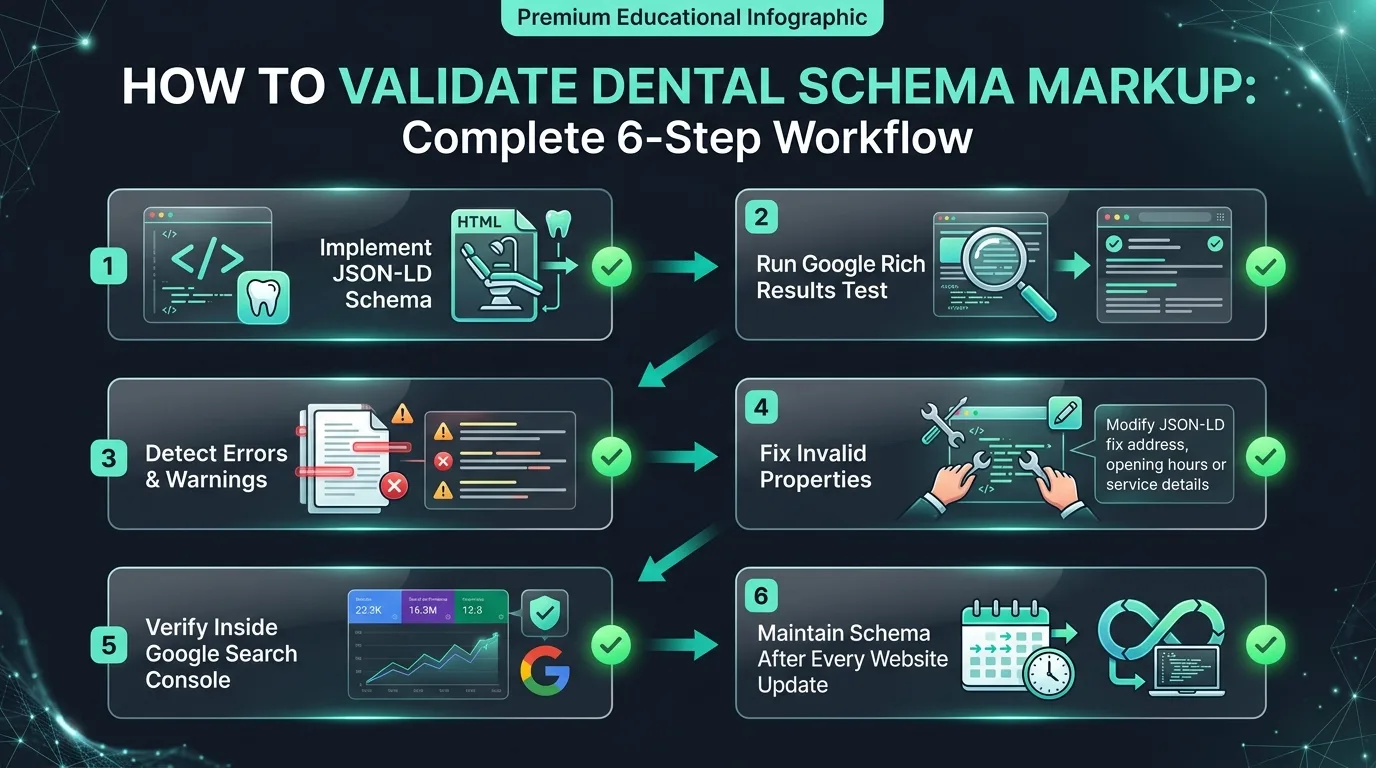 Figure 5: Checking structured tags via Google Rich Results Tool ensures clean syntax validation.
 Schema Markup as the Foundation of GEO and AEO
Every dental practice and dental marketing agency needs to accept this reality clearly. Traditional dental SEO is no longer enough. It has not been enough for some time. Patients are using AI tools to find dental care in growing numbers, and the practices that appear in AI-generated answers are not necessarily the ones with the most keyword-optimized content. They are the ones whose websites are technically structured for machine readability and AI trust.
Generative Engine Optimization, or GEO, is the strategy of building your dental website and content so that AI tools like ChatGPT, Perplexity AI, Google Gemini, SearchGPT, and Microsoft Copilot recognize your practice as a verified, authoritative source. Schema markup is the most direct technical contribution to GEO. It gives AI tools verified, structured practice information they can cite without ambiguity. Dental practices that have complete schema implementations across local business, FAQ, review, service, and medical organization types are consistently the ones that AI tools trust most and recommend most often. Review strategy rules in our Generative Engine Optimization guide.
Answer Engine Optimization, or AEO, means building dental website content that answer engines and voice assistants can extract and deliver directly to patients as spoken or written answers. FAQ schema is the core AEO tool for dental practices. Combined with clear, direct answer content, FAQ schema turns your dental service pages into sources that AI tools pull from whenever a patient asks a relevant dental question through any AI-powered channel. Review techniques in our zero-click search strategy guide.
Schema markup is not optional for dental practices that want to compete in modern dental search. It is the technical foundation that connects your dental website to search engines, AI tools, and voice assistants across every platform patients use to find dental care today.
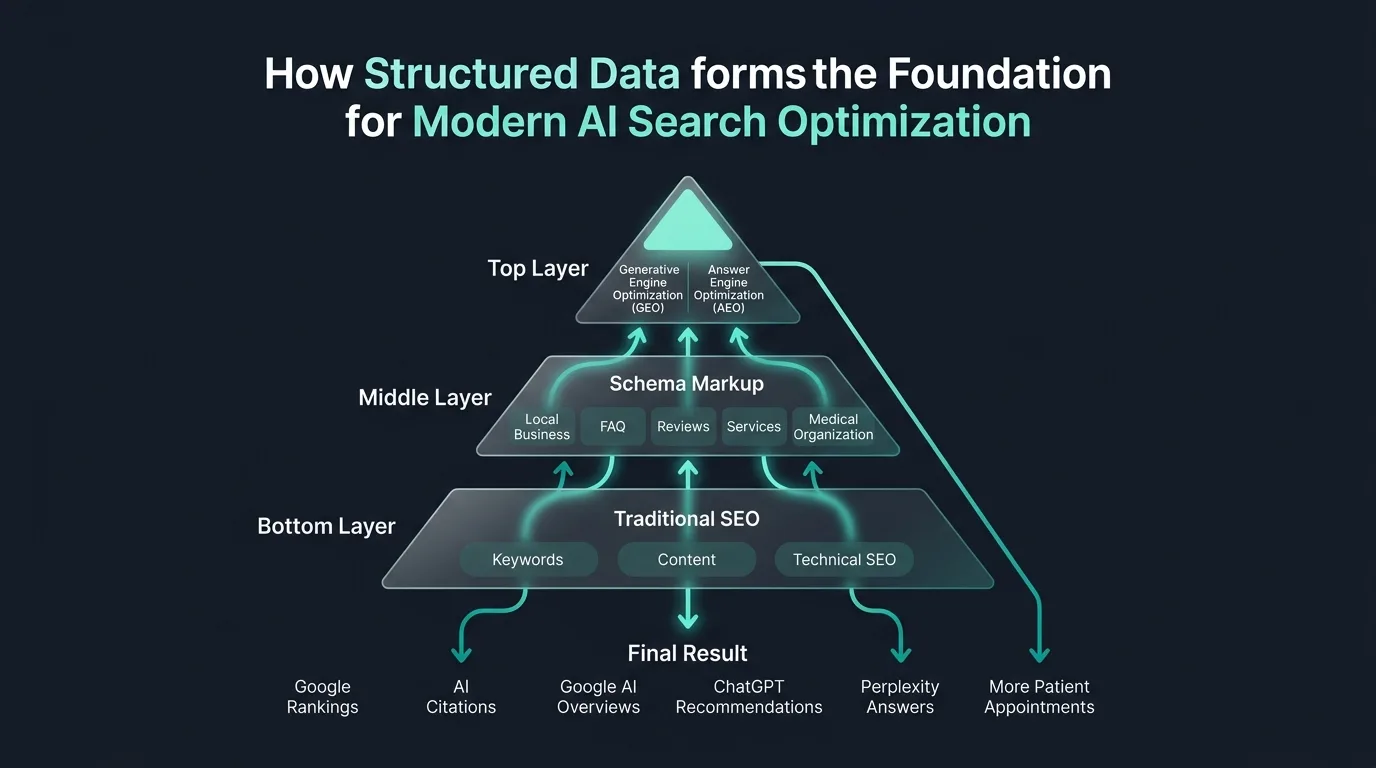 Figure 6: Schema tags provide clean, high confidence parameters that power generative recommendations.
 Final Thoughts
Schema markup implementation for dental practices is a clear, manageable process when approached methodically. Start with local business schema on your homepage and location pages. Add FAQ schema to every service page. Implement review schema to communicate your reputation. Add service schema for your highest-value treatments. Apply medical organization and dentist-specific schema to confirm your healthcare authority. Test everything with Google's Rich Results Test. Monitor ongoing performance in Google Search Console.
Do all of this as part of a broader dental SEO strategy that includes Generative Engine Optimization and Answer Engine Optimization. Schema markup is what makes your dental website legible to machines. GEO is what makes AI tools trust your practice enough to recommend it. AEO is what makes your content the answer that AI tools deliver to patients who are ready to book.
Traditional dental SEO brought practices to the top of search result pages. Schema markup and AI-focused optimization bring practices to the top of the answer itself. In dental marketing today, being the answer is everything. Focus on mobile loading speeds by looking at our dental mobile SEO guide.

Ready to Dominate Local & AI Search?
Navigating the complexity of Local Map Packs, traditional search rankings, and emerging AI engine visibility can be difficult. Schedule a practice growth audit with our dental SEO specialists today. We will analyze your practice listings, audit your competitor strategies, and layout the exact plan needed to capture high-value cases.
Schedule Growth AssessmentFrequently Asked Questions
JSON-LD stands for JavaScript Object Notation for Linked Data. It is officially recommended by Google because it keeps structured markup in a separate script block, preventing page breaks and making it highly legible for search and AI indexers.
The Dentist schema (a subtype of LocalBusiness and MedicalBusiness) is primary, accompanied by FAQ schema on service pages, Review schema to display aggregate ratings, and Service schema to list specific treatments.
You should use Google's Rich Results Test for per-page validation. Additionally, monitor the structured data reports inside Google Search Console to track errors or warnings.
Structured schema markup translates raw text into clear, machine-readable facts (like practice address, services, and doctor profiles), enabling platforms like ChatGPT and Perplexity AI to recommend and cite your dental office with confidence.
Yes. Correct implementation of AggregateRating under Review schema enables search engines to display star ratings and total review counts directly within search listings as rich snippets.