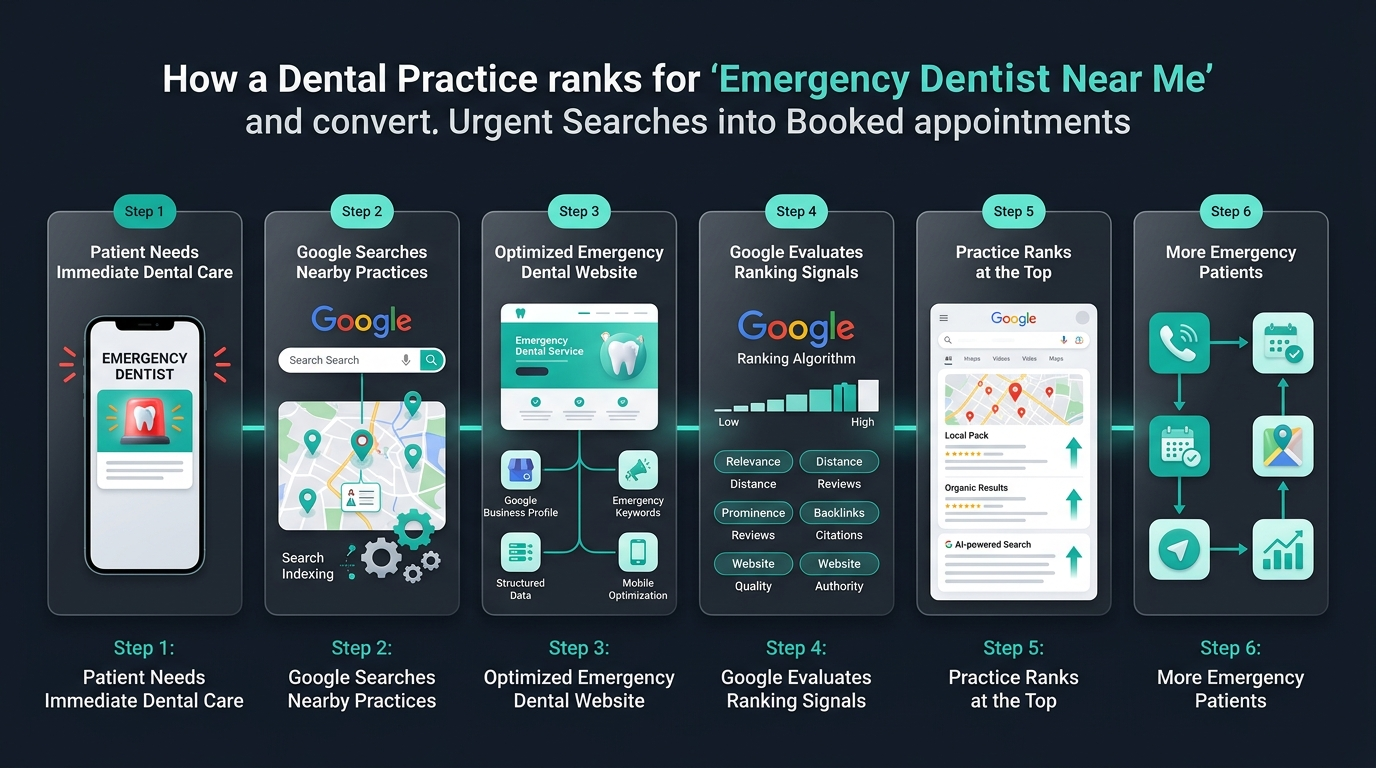
Key Takeaways
When a patient is in pain, they do not browse. They search fast, click fast, and call fast. The phrase emergency dentist near me is one of the most valuable searches in all of dental marketing. If your practice is not showing up for that phrase, you are losing patients every single day to a competitor who figured out dental SEO before you did. This blog breaks down exactly what it takes to rank for that search term. You will learn how local SEO for dentists works, what dental SEO strategies actually move the needle, and why AI tools like ChatGPT, Perplexity, and Google Gemini are now part of the game. Whether you are working with a dental SEO agency or doing this yourself, this guide gives you a clear road map to follow.
- High Intent Leads: Emergency queries target same-day care. Dominating the Maps Local 3-Pack is the primary pipeline.
- Google Business Profile Tuning: Set correct secondary categories, maintain accurate hours, and build a rapid review generation engine.
- On-Page Strategy: Create a unique emergency services page optimized for local neighborhoods and keywords.
- GEO & AEO Focus: Use proper schema markup and answer patient queries directly to get cited in generative AI answers.
- Why Ranking for Emergency Dentist Near Me Is Worth Fighting For
- How Google Decides Who Ranks for Emergency Dentist Near Me
- Step One: Optimize Your Google Business Profile for Emergency Searches
- Step Two: Build a Dedicated Emergency Dental Services Page
- Step Three: Use the Right Dental SEO Keywords Throughout Your Site
- Step Four: Build Local Authority With Citations and Backlinks
- Step Five: Create Content That Answers Emergency Dental Questions
- Traditional SEO Is No Longer Enough: Why GEO and AEO Now Matter
- How to Get Your Dental Practice Cited by ChatGPT, Perplexity, and Google Gemini
- Ranking in Specific AI Engines: What Dental Practices Need to Do
- Choosing a Dental SEO Company That Understands the Full Picture
- Measuring Your Dental SEO Results
- Conclusion: Start Ranking for Emergency Dentist Near Me Today
- Frequently Asked Questions
Why Ranking for Emergency Dentist Near Me Is Worth Fighting For
The phrase "emergency dentist near me" has buying intent behind it. The person typing it is not doing research. They are not comparing options slowly. They are in pain and they want help right now. That makes this keyword one of the highest-converting terms in all of dental SEO marketing.
Dental practices that rank for this phrase see real results. More calls. More same-day appointments. More new patients who become long-term patients. This is the type of patient acquisition that every private dental practice, solo practitioner, and multi-location dental group is chasing.
But ranking for it is not easy. Google shows only a handful of results before someone has to scroll. The map pack at the top shows only three listings. If you are not in those three (the Google Map Pack) or in the first few organic results below them, you are essentially invisible to a patient in pain.
That is why dental search engine optimization for this specific keyword needs a focused, complete strategy, not a few random updates to your website.
How Google Decides Who Ranks for Emergency Dentist Near Me
Before you can rank, you need to understand what Google is looking at. For local searches like "emergency dentist near me," Google uses three main signals to decide who shows up.
- Relevance: Does your website and Google Business Profile clearly say that you offer emergency dental services? If Google cannot confirm this easily, you will not rank for it.
- Distance: Google shows results that are physically close to where the person is searching. This is why local SEO for dentists matters so much. Your practice needs to be visible in your specific geographic area, not just in a general online sense.
- Prominence: How well-known and trusted is your practice online? This includes your reviews, your backlinks, your mentions on other websites, and your overall digital footprint. A dental SEO company that understands prominence will build your authority across multiple channels, not just your website.
Understanding these three factors is the foundation of any strong seo for dental practices. Every tactic we cover in this blog connects back to one of these three signals.
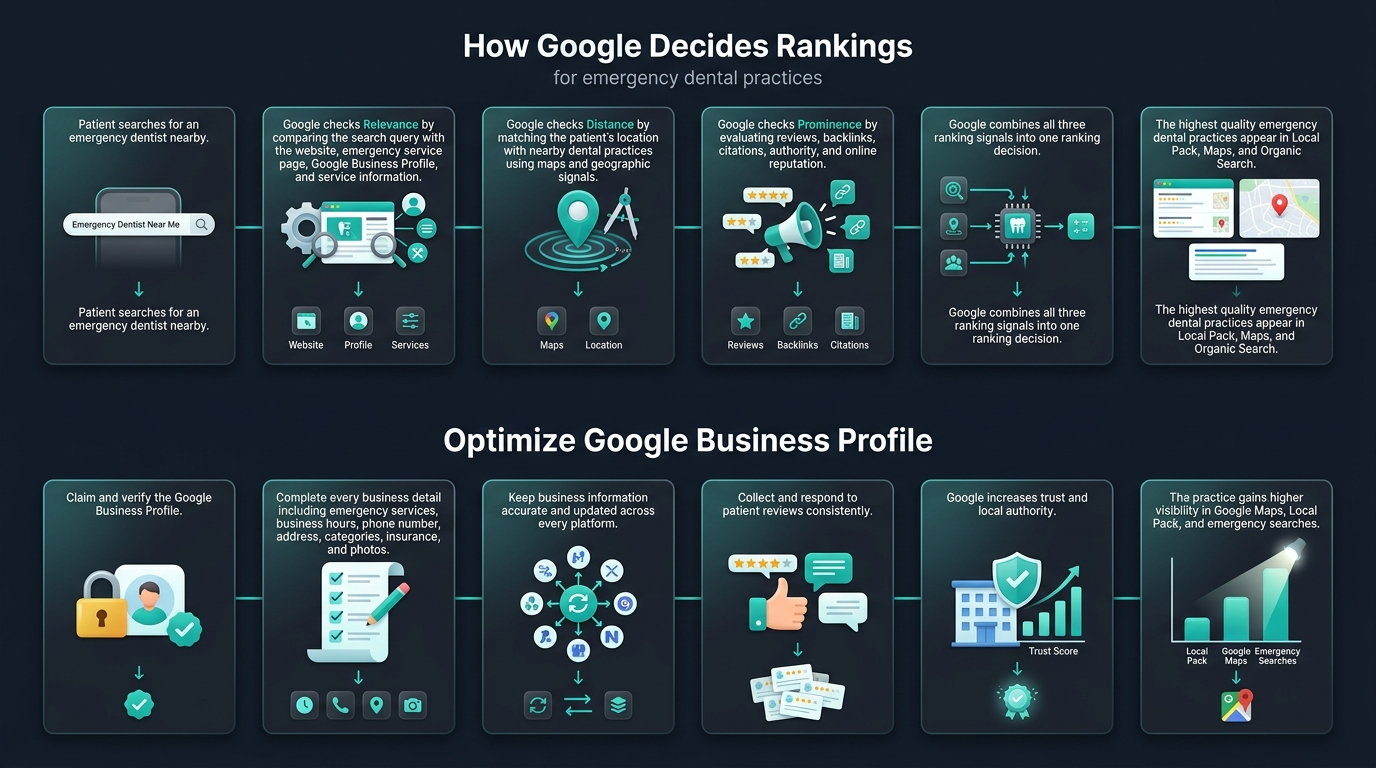 Figure 1: Syncing geographical signals and clinical relevance helps anchor map visibility.
 Step One: Optimize Your Google Business Profile for Emergency Searches
Your Google Business Profile is the single most powerful tool for ranking in local search for dentists. It controls what shows up in the map pack, which appears above all organic results for location-based searches. Learn more in our GBP setup guide.
Here is what your profile needs to rank for emergency dentist searches:
- Accurate Categories: Your primary category should be "Emergency Dental Service" or "Dentist" depending on what Google allows in your area. Review our guide to the best GBP categories for dentists to get it right.
- Practice Name Consistency: Your business name should be your actual practice name. Do not stuff keywords into your business name. Google penalizes this and it looks unprofessional.
- Availability Hours: Your hours must be accurate and complete. If you offer after-hours emergency care or weekend appointments, say so clearly. Patients searching for an emergency dentist are specifically looking for availability. Make it easy for them to see that you are open.
- Profile Photos: Add photos regularly. Practices with more photos get more views and more clicks. Show your front desk, your treatment rooms, your team, and your technology. Real photos build trust faster than stock images. See our recommendations for GBP photos for dentists.
- Weekly Google Updates: Post updates regularly using the Posts feature. Share information about emergency services, new technology, patient stories, and anything that keeps your profile active. Google rewards active profiles in dental local SEO rankings. Learn more in our guide on GBP posts for dentists.
- Consistent Reputation Management: Finally, collect and respond to every Google review. Reviews are one of the strongest local SEO signals. A practice with 200 five-star reviews will almost always outrank a practice with 20, everything else being equal. Ask every happy patient to leave a review. Make it simple by sending them a direct link. Read our guide on how to respond to reviews, and track your views in GBP insights (read our guide to understand how to read GBP insights).
Step Two: Build a Dedicated Emergency Dental Services Page
One of the biggest mistakes dental practices make is not having a specific page for emergency dental services. A general "Services" page is not enough. If you want to rank for "emergency dentist near me," you need a page built specifically for that search (like an optimized emergency dentist service page).
This page should do several things well:
- Target Keywords: It should target the right dental SEO keywords from the very first paragraph. Phrases like "emergency dentist," "same day dental care," "dental emergency," and "urgent dental services" should appear naturally throughout the content.
- Patient FAQs: It should answer the questions a patient in pain is actually asking. What counts as a dental emergency? How quickly can I be seen? What should I do before I come in? Does insurance cover emergency dental visits? How much will it cost? These are real questions with real answers, and your page should provide them clearly and directly.
- Prominent CTA: It should include your phone number and a click-to-call button at the top of the page. Do not make a patient in pain scroll to find how to contact you. Put your number front and center.
- Localized Copy: It should include your location and service area. Mention your city and surrounding neighborhoods naturally within the content. This helps with neighborhood SEO pages and multi-location pages, telling Google exactly where you serve patients.
- Mobile Optimization: It should load fast on a phone. Most emergency searches happen on mobile devices. If your page takes more than three seconds to load, patients will leave and call the next practice on the list. Dental website speed optimization is not optional.
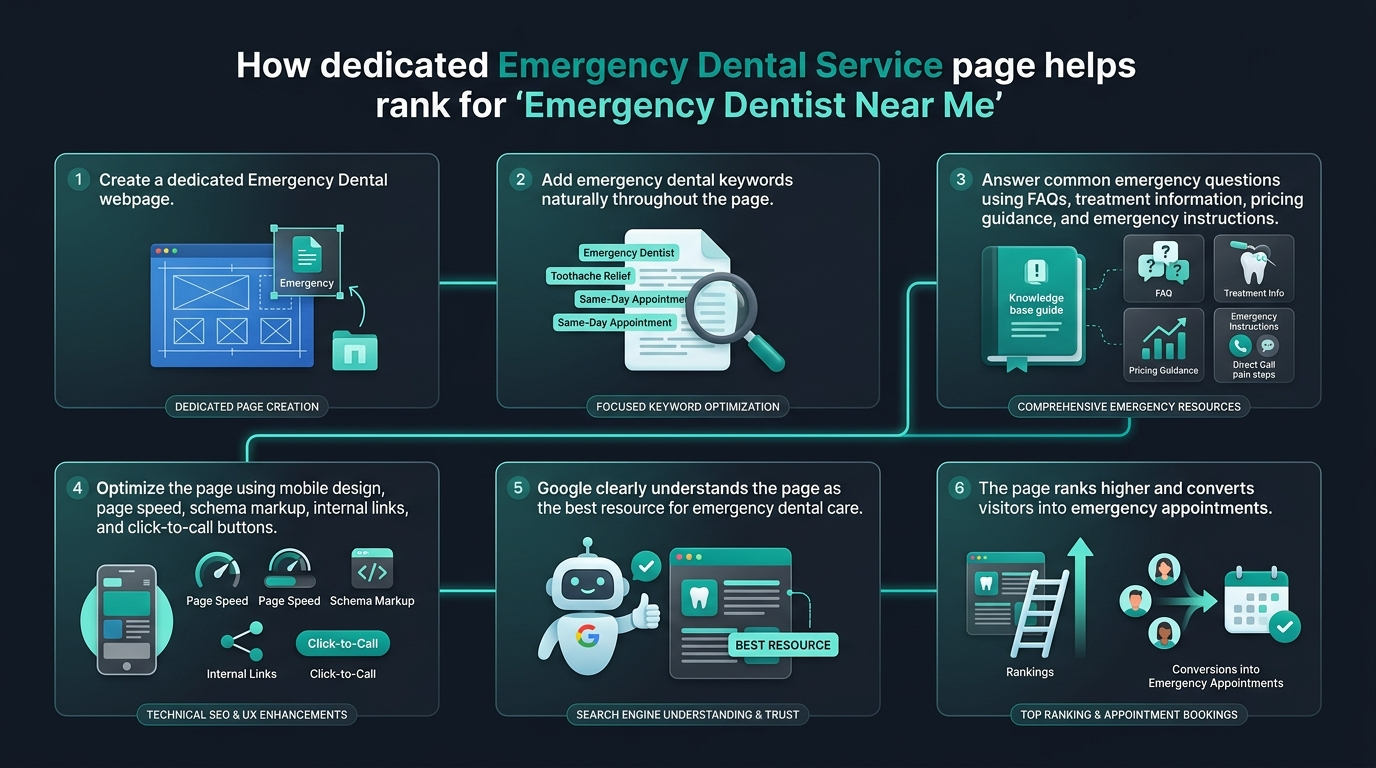 Figure 2: Dedicated pages with immediate calls to action capture mobile searches faster.
 Step Three: Use the Right Dental SEO Keywords Throughout Your Site
Dental SEO keywords are the specific words and phrases that patients type when searching for a dentist. For ranking in emergency searches, you need to use these keywords strategically across your entire website.
Start with your homepage. Make sure it is clear from your homepage that you offer emergency dental care. Your main headline, your intro paragraph, and your services section should all reference emergency services.
Then look at your service pages, your blog posts, your about page, and your contact page. Every page is an opportunity to include relevant dental SEO keywords and show Google that emergency dental care is a core part of what you offer.
Some of the most important dental SEO keywords for this goal include: emergency dentist near me, same day dentist, dental emergency, emergency tooth extraction, emergency root canal, cracked tooth emergency, lost filling, dental pain relief, and after hours dentist.
Do not stuff these keywords in awkwardly. Write naturally. Include them where they make sense. A good dental SEO specialist will know how to weave keywords into content so that it reads well for patients and performs well for search engines at the same time.
Also use related terms and entities. Words like patient acquisition, treatment acceptance, dental practice growth, new patients, and online visibility all reinforce the topic and help your content perform better in search intent mapping, which is how modern dental search engine optimization works.
Step Four: Build Local Authority With Citations and Backlinks
Google needs to see that your dental practice is trusted by the rest of the internet before it will put you at the top of local search results. Two of the most important ways to build that trust are citations and backlinks.
Citations are listings of your practice name, address, and phone number on other websites. Being listed accurately on Yelp, Healthgrades, Zocdoc, WebMD, and local business directories all send trust signals to Google. A dental local citations auditing process ensures your details remain consistent across all directories, including the best dental directories.
Backlinks are links from other websites pointing to yours. A local news article that mentions your practice, a guest blog post on a health website, a partnership with a local business, all of these create backlinks. The more quality backlinks you have, the more Google sees your practice as an authority.
For emergency dental practices, local backlinks matter most. A link from your city's chamber of commerce website, a local parenting blog, or a community health organization carries more weight than a link from a random website in another country. This is the foundation of a solid local link building campaign, including community backlinks, sponsorship links, press release PR links, and guest posting.
Link building takes time. It is one of the slower parts of dental SEO strategy. But it is also one of the most powerful. Practices that invest in consistent link building over time build a wall of authority that competitors struggle to break through.
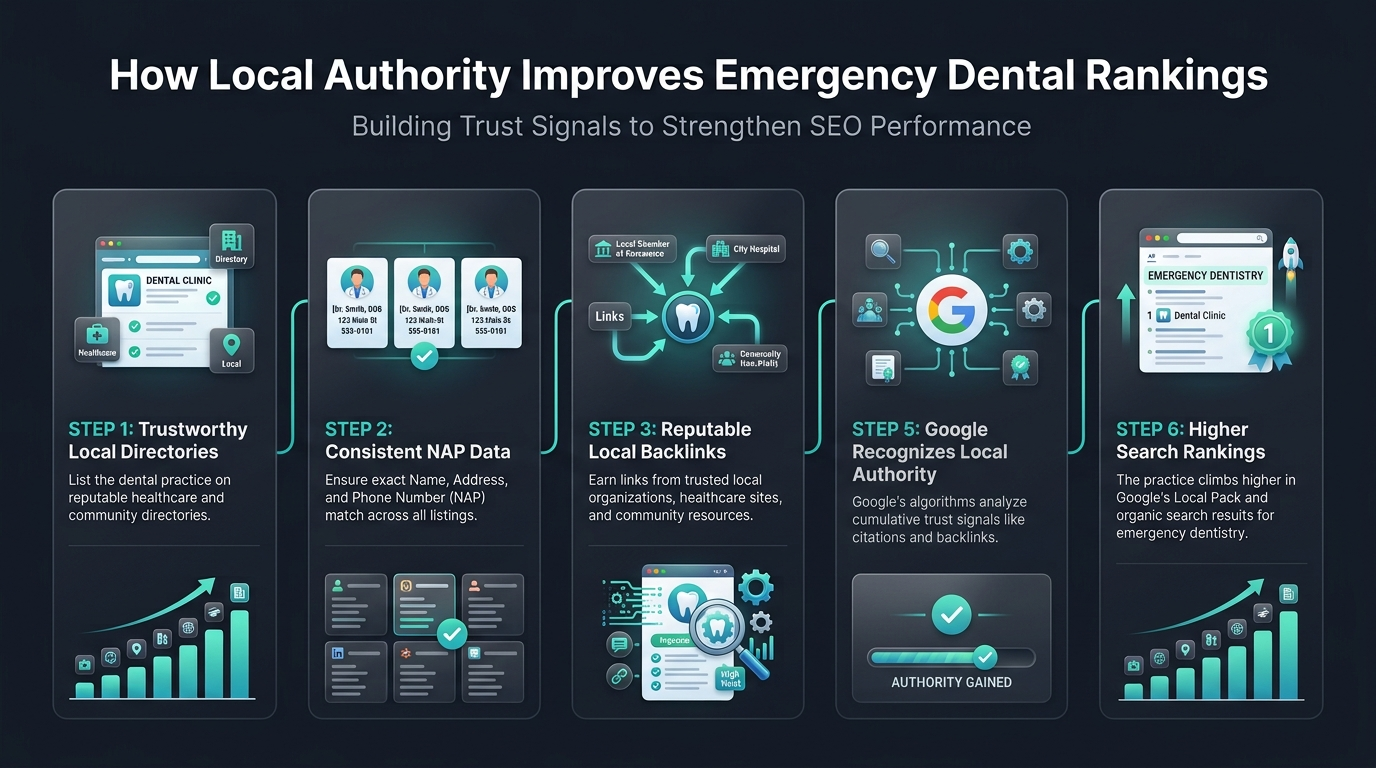 Figure 3: Acquired backlinks and unified listings verify regional prominence to search algorithms.
 Step Five: Create Content That Answers Emergency Dental Questions
Content marketing is one of the most cost-effective dental SEO strategies available. When you create helpful blog posts, FAQs, and guides that answer real patient questions, you attract organic traffic month after month without paying for every click.
For ranking in emergency dental searches, focus your content on questions patients ask in moments of pain and worry. Here are some proven content ideas:
- What to do if you knock out a tooth.
- How to stop dental pain at home until you can see a dentist.
- Signs that a toothache is a real dental emergency.
- How to handle a broken tooth over the weekend.
- What happens during an emergency root canal.
- Does dental insurance cover emergency visits.
- How to find an emergency dentist that is open right now.
Each of these topics can be its own blog post. Each post targets specific long-tail keywords that real patients search for. Over time, this library of content builds your authority in the eyes of both Google and AI tools.
Write at a clear, readable level. Use short sentences. Use everyday words. Organize your content with clear headings. Answer the question in the first paragraph, then go deeper. This is exactly the format that earns high rankings in Google AI Overviews and gets cited by AI answer engines like Perplexity.
Traditional SEO Is No Longer Enough: Why GEO and AEO Now Matter
Here is one of the most important things you need to understand about dental SEO today. Ranking on Google is still important. But it is no longer the only game in town.
Millions of people now ask AI tools like ChatGPT, Perplexity AI, Google Gemini, Microsoft Copilot, and SearchGPT for recommendations and answers. When someone asks ChatGPT "what should I do about my toothache tonight" or asks Perplexity "find me an emergency dentist in Dallas," those AI tools give direct answers. They do not show a list of blue links. They name specific sources and practices that they have determined to be trustworthy and well-documented.
This is where Generative Engine Optimization, or GEO, comes in. GEO is the strategy of optimizing your online presence so that AI tools recognize your practice as a reliable source and recommend you in their answers. It goes beyond traditional dental search engine optimisation. It requires that your content be structured in a way that AI engines can read, understand, and cite with confidence.
There is also Answer Engine Optimization, or AEO. AEO focuses on making sure your content directly answers questions in a clear, factual way so that AI tools like Perplexity pull your content as the answer to a patient query. If your page answers "what is a dental emergency" with a clear, direct, well-organized response, Perplexity is more likely to cite your practice as a source.
Dental practices that ignore GEO and AEO today are making a strategic mistake. The patients of tomorrow are already using these tools. The practices that show up in AI answers will have a massive competitive advantage.
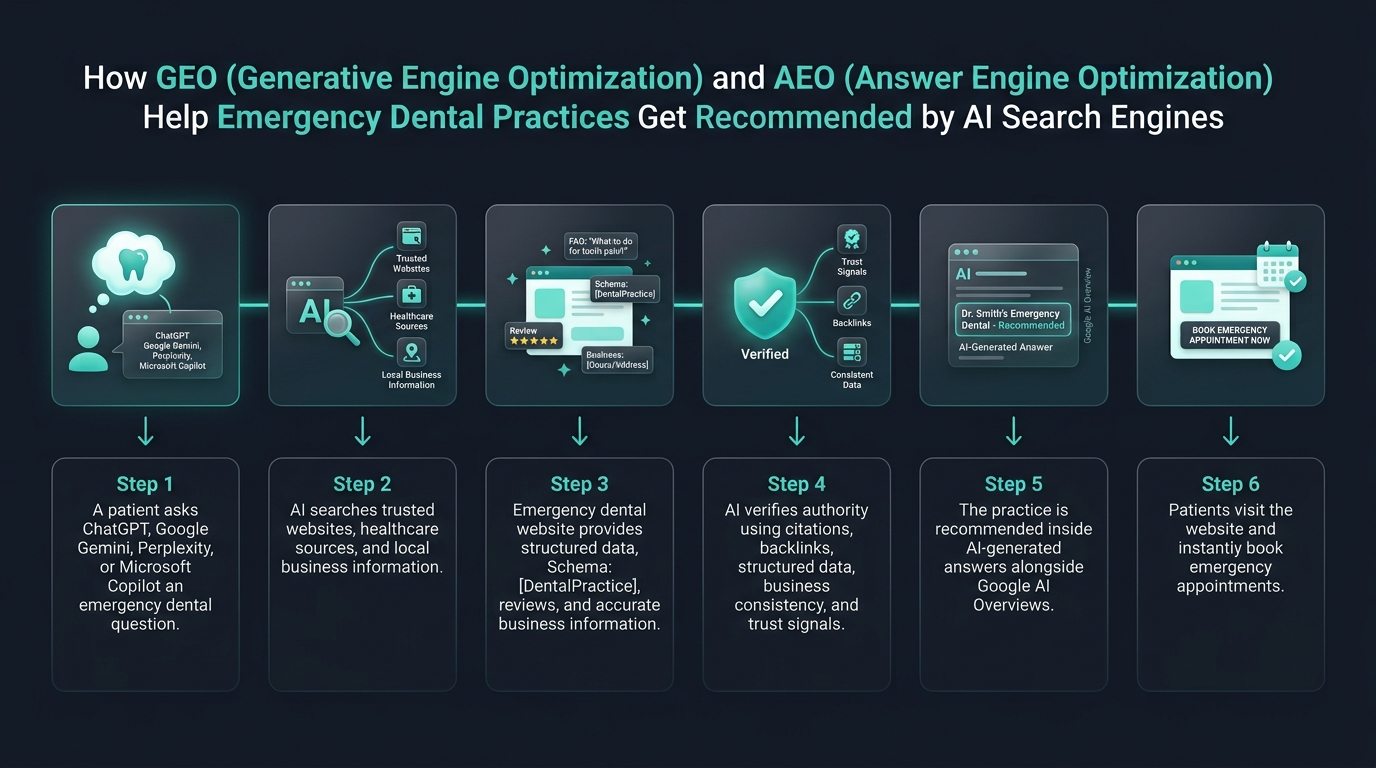 Figure 4: AEO and GEO strategies secure recommendations inside conversational AI environments.
 How to Get Your Dental Practice Cited by ChatGPT, Perplexity, and Google Gemini
Getting cited by AI tools is not random. It is the result of deliberate dental SEO and digital marketing choices. Here is how it works.
AI tools are trained on large amounts of web content. They learn which sources are reliable, authoritative, and consistent. When a patient asks an AI a dental question, the AI pulls information from the sources it has learned to trust. If your dental website is one of those sources, you get cited. If it is not, a competitor's site gets cited instead.
To become a source that AI tools trust, your website needs several things:
- Factual, Specific Content: It needs content that is accurate, specific, and clearly written. Vague or thin content does not get cited. Detailed, helpful content that gives real answers does. We target AI browsing models with a structured zero-click strategy.
- Structured Schema Markup: It needs structured data and schema markup. This is code added to your website that tells search engines and AI tools exactly what your content is about. For a dental practice, schema can describe your services, your location, your hours, your reviews, and your credentials. A dental SEO expert or dental SEO specialist can add this to your site correctly.
- Consistency Across Channels: It needs consistent information across the entire web. If your practice name, address, phone number, and services are described differently on different websites, AI tools will not trust your information. Consistency across your website, your Google Business Profile, your social media profiles, and all your directory listings is essential.
- External Validation: It needs external validation. When trusted websites link to yours or mention your practice, AI tools take note. Earning mentions and backlinks from dental associations, health publications, local news outlets, and community organizations all add to your AI visibility. Focus on building authority using E-E-A-T principles.
Ranking in Specific AI Engines: What Dental Practices Need to Do
Each AI platform works slightly differently. Here is a breakdown of how to approach the major ones:
- ChatGPT and SearchGPT: ChatGPT with browsing enabled pulls live information from the web. It heavily favors content indexed by Bing. To rank in ChatGPT responses, make sure your dental website is verified and indexed in Bing Webmaster Tools. Write content in a conversational, question-and-answer format. Give direct answers immediately. ChatGPT does not summarize hedging or vague content. It cites sources that are specific and clear.
- Perplexity AI: Perplexity is designed as an answer engine. It searches the web and compiles a direct answer with citations shown to the user. To get featured in Perplexity, your content needs to answer questions in the first sentence or two. Use clear headings that match the questions patients ask. Include specific facts, numbers, and actionable advice. Perplexity also favors sites with strong backlink profiles, so link building remains a key part of dental SEO internet marketing even for AI visibility.
- Google AI Overviews: Google AI Overviews appear at the very top of the search results page, above all organic listings. They pull content from pages Google already trusts. To earn a spot in a Google AI Overview, your page needs to be fast, mobile-friendly, and structured with clear headings. It needs to answer the target question within the first paragraph. And it needs to be on a website that Google has already identified as authoritative through strong rankings, good reviews, and quality backlinks. Learn more in our guide on how to appear in AI Overviews and optimize for voice search queries.
- Microsoft Copilot: Microsoft Copilot is powered by Bing. Optimizing your dental website for Bing search is the most direct path to visibility in Copilot. Claim your Microsoft Places listing. Make sure your content uses natural language and answers questions directly. Add structured data so Copilot can understand your services, location, and credentials without confusion.
Choosing a Dental SEO Company That Understands the Full Picture
If you are working with a dental SEO company or planning to hire one, know what to look for. The dental SEO industry has many agencies that are still running strategies from five years ago. You need a dental SEO agency that understands both traditional seo for dental offices and the new world of AI search.
Ask any dental SEO company you are considering these questions:
- Do you have experience with local SEO for dentists specifically?
- Can you show me examples of dental practices you have helped rank?
- Do you understand GEO and AEO?
- How do you approach AI search visibility alongside traditional Google rankings?
- What does your reporting look like and how do you tie results back to new patient acquisition?
The best dental SEO marketing companies will have clear answers to all of these questions. They will talk about practice growth, patient leads, treatment acceptance, and revenue generation, not just keyword rankings. They will combine dental SEO services with website conversion rate optimization so that the traffic you earn actually turns into phone calls and booked appointments. Review typical packages and dental local SEO cost details.
A dental SEO consultant or dental SEO specialist can also be a good starting point if you want expert guidance without committing to a full agency relationship. They can audit your current dental website optimization, identify the biggest gaps, and build a dental SEO strategy tailored to your specific practice and market. Use our custom local SEO audit guide to run a self-check.
Measuring Your Dental SEO Results
Rankings alone are not the goal. New patients are the goal. A strong dental SEO marketing service will track the right metrics so you know exactly what your investment is producing.
Key things to track include:
- Your ranking position for 'emergency dentist near me' and related terms.
- Your Google Business Profile views and call clicks.
- Your website traffic from organic search.
- The number of new patient leads coming from your website.
- Your call volume and appointment bookings.
- Your collected revenue tied back to patients who found you through search.
Modern dental local SEO marketing agencies use marketing attribution tools that connect your SEO performance to your practice management software. This gives you a clear picture of exactly which marketing activities are generating revenue and which ones need adjustment. Audit your systems using a complete dental local SEO checklist.
Conclusion: Start Ranking for Emergency Dentist Near Me Today
Ranking for 'emergency dentist near me' is one of the highest-value goals in all of dental practice marketing. It puts your practice in front of patients at the exact moment they are ready to call. It drives new patient acquisition, increases practice revenue, and builds long-term practice growth.
The path to that ranking requires a complete dental SEO strategy: a fully optimized Google Business Profile, a dedicated emergency services page, the right dental SEO keywords throughout your site, strong local citations and backlinks, regular helpful content, and a growing presence in AI engines through GEO and AEO.
Traditional SEO is not dead. But it is no longer enough on its own. The practices that will dominate local search for dentists over the next decade are the ones investing now in both Google rankings and AI visibility.
Whether you work with a dental SEO agency, a dental SEO consultant, or build your strategy in house, the most important step is to start. Every week you wait is another week an emergency patient calls your competitor instead of you.
Invest in dental search engine optimization today. Get found tomorrow.
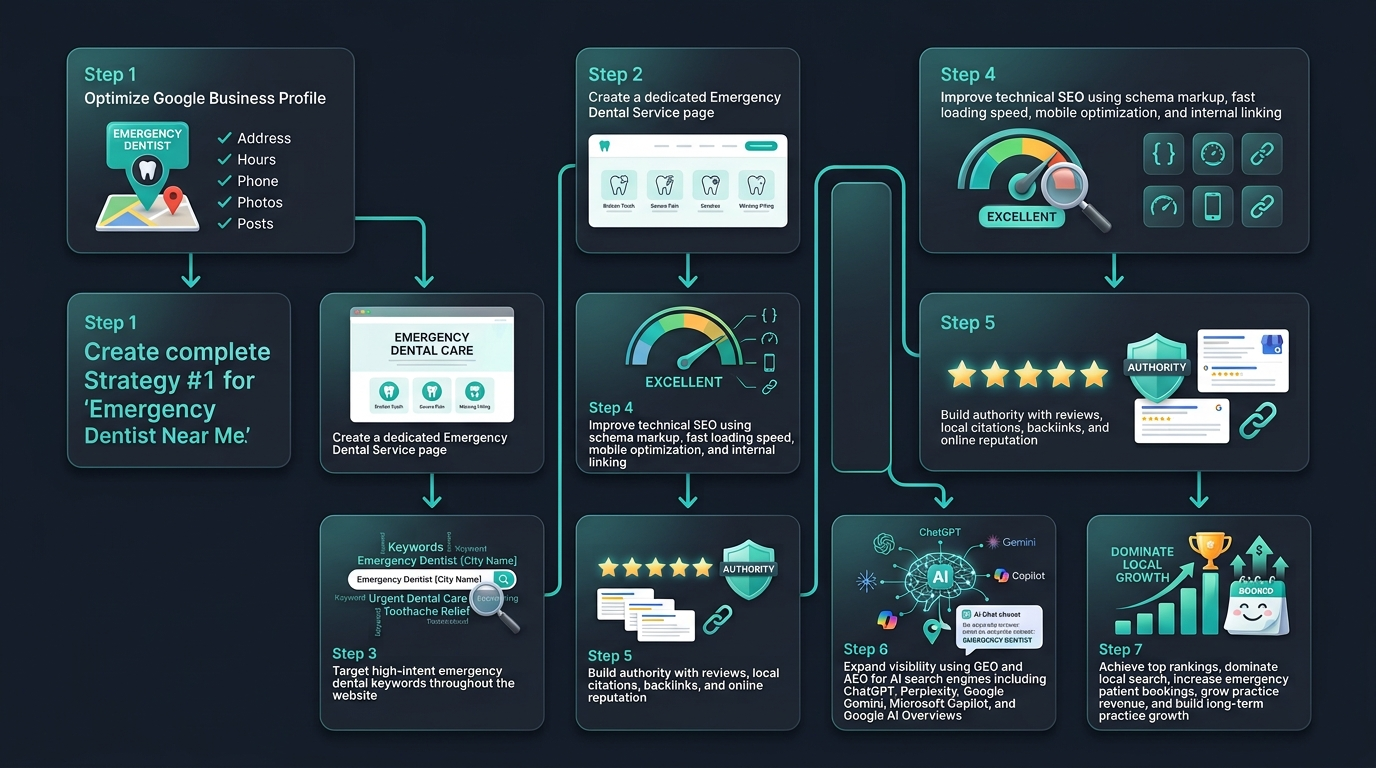 Figure 5: Building a comprehensive ranking framework delivers consistent new patient growth.
Ready to Dominate Local & AI Search?
Navigating the complexity of Local Map Packs, traditional search rankings, and emerging AI engine visibility can be difficult. Schedule a practice growth audit with our dental SEO specialists today. We will analyze your practice listings, audit your competitor strategies, and layout the exact plan needed to capture high-value cases.
Schedule Growth Assessment